Designing for Safety & Belonging
Promoted mid-project to lead 8 designers across 4 agile sprints — delivering a privacy-first MVP for an LGBTQIA+ mentorship platform, with full stakeholder presentation at Phase 3.
An ADPList for the Queer Community
Thrive Out Loud is a mentorship platform built for Sean's Legacy, a nonprofit dedicated to supporting LGBTQIA+ youth. The product connects young queer professionals with experienced queer mentors — providing guidance that generic mentorship platforms can't offer.
I joined as a UX Design Apprentice through Tech Fleet, contributing to the mentee profile creation flows. Midway through, I was elevated to Design Lead, where I managed a team of 8 apprentice designers across two months and four sprints.

Trust Is the Product
LGBTQIA+ individuals face a real scarcity of dedicated professional resources — mentorship spaces where their identity isn't a footnote, but the whole point. Generic platforms can't account for the nuances of navigating a workplace as a queer person. That gap is what Thrive Out Loud was built to close.
For this user base, the design stakes were uniquely high. We were designing for people who may not be out to their families, employers, or communities. A privacy misstep isn't just a UX failure — it could put someone at genuine risk.
How do we create a mentorship onboarding experience that makes users feel safe enough to be honest — while keeping the platform warm and welcoming rather than sterile and clinical?
This wasn't just a design value — it was a formal product constraint. Data privacy and legal compliance were listed alongside funding and technical complexity as the product's top risks, with zero data breaches defined as a hard success metric from day one.
What research told us — The UXR team ran moderated usability tests (remote 1:1 sessions, N=5–6, LGBTQIA+ participants only) on the mentee flow across sign-up, onboarding, and mentor search. Two findings shaped design decisions directly:
Identity Labels Matter Deeply
Participants wanted more accurate and specific gender and identity categories — but proposed solutions varied significantly across users. We designed for editability and flexibility rather than a fixed taxonomy.
Vetting Transparency Builds Trust
Participants were confused about who vets mentors and by what criteria. Lack of transparency in the screening process undermined the sense of safety the platform was meant to provide — a direct signal that trust had to be designed, not assumed.
The onboarding flow was designed around a clear minimum: chosen name, pronouns, time zone, and focus area. Everything beyond that is the user's choice. This distinction — between what the platform needs to function and what the user chooses to share — was a deliberate privacy boundary, not a default.

Two Roles, One Team
As UX Apprentice — I worked within the design system alongside leads, focusing specifically on the mentee profile creation user flows.
User Flow Charts
End-to-end mentee profile creation paths with privacy branching logic
Personas
Queer youth profiles capturing varying levels of outness and comfort — from fully out to closeted at work
Storyboards
Contextual scenarios showing how users would encounter privacy decisions in real life
Prototypes
Low-to-high fidelity, iterated across sprints with team feedback and design system constraints
Mentor vetting was one of our most debated design questions. We needed to communicate the background check process clearly and early — without making it feel punitive or opaque. The flow maps every approval state explicitly, including the waiting screen and rejection path, because ambiguity at this stage would have undermined the community trust the platform was built on.

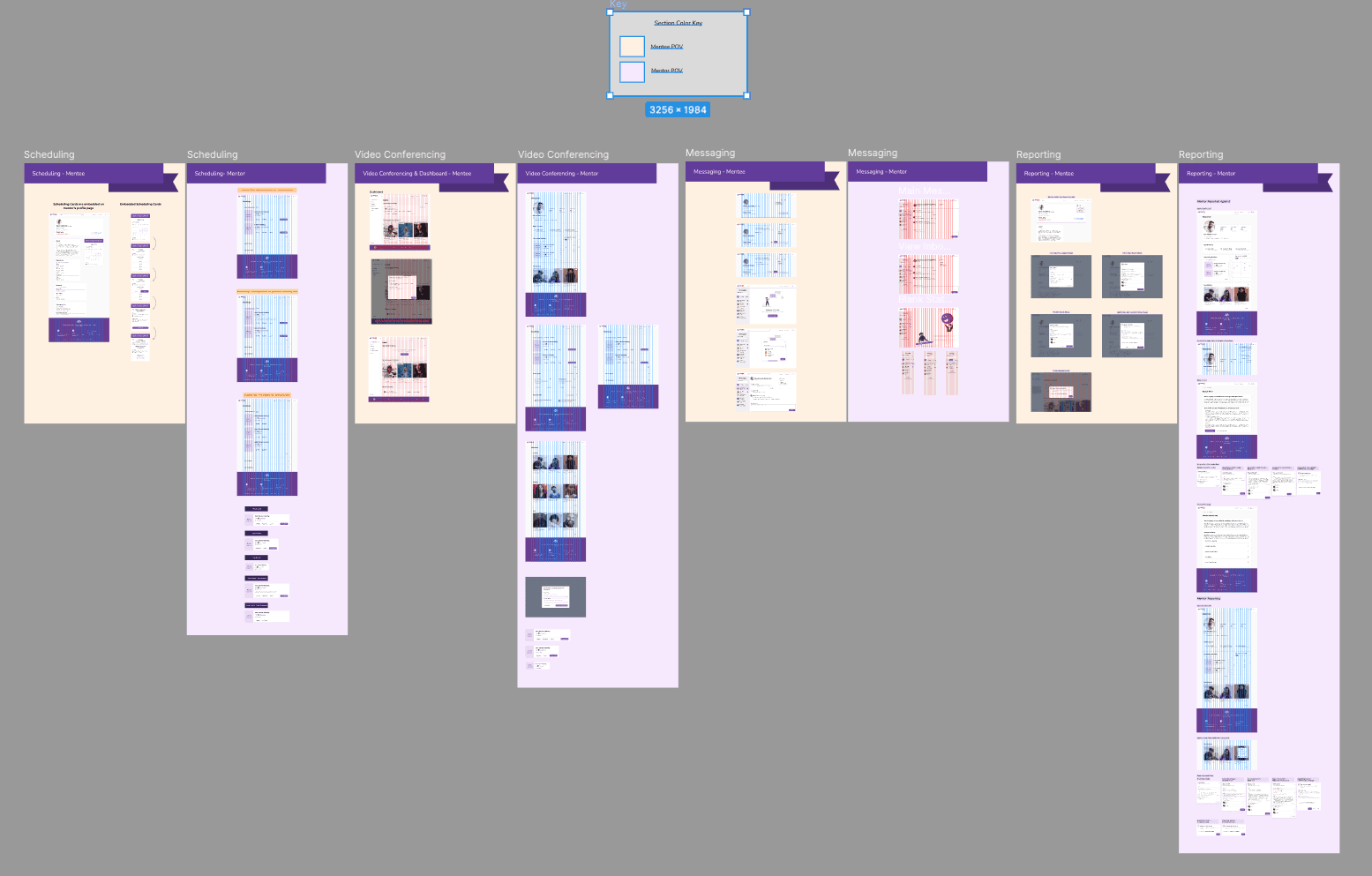
As Design Lead — I transitioned into managing the team's process, output, and morale across 4 sprints. Design didn't happen in isolation — we operated inside a full cross-functional product org alongside UX Research, UX Writing, Product Strategy, and Dev teams. I used a cross-team liaison model to keep design decisions aligned across every workstream in real time.
Feature Prioritization
Worked with the product team to apply a MoSCoW prioritization framework to the feature backlog — distinguishing what had to ship in Phase 3 from what needed to be handed off as recommendations for future phases.
Sprint Cadence
Two team meetings per week — design reviews, workshops, critique, and team-building. Async standups in Slack kept momentum between sessions across a fully remote team.
Cross-functional Alignment
Used a liaison system — having design representation in UXR, Product, and Dev meetings — to catch misalignments early and keep the design system consistent across the product.
Sprint Planning & Retros
Bi-weekly planning and retrospectives gave the team structure and a safe space to surface blockers, recalibrate priorities, and reflect on process.
1:1 Mentorship
Individual sessions with each apprentice to unblock design problems, build confidence, and support their growth as practitioners — not just contributors to a deliverable.
An MVP Delivered. A Lesson in Ownership.
At the end of Phase 3, the team presented a full MVP to stakeholders — a privacy-centered mentorship onboarding experience built to measurable success criteria, including mentor-mentee match satisfaction, WCAG accessibility compliance, and zero data breaches.
Usability testing validated the core flow: participants were able to successfully complete sign-up, edit their profiles, and identify a mentor — citing the clarity of content and straightforwardness of the user flow as primary reasons. That outcome didn't happen by accident. It was the direct result of iterating on UXR findings across four sprints.
We also delivered a full Phase 4 recommendations document — outlining responsive design needs, edge case coverage, content audits, and heuristic evaluation priorities — so the next team could hit the ground running.
Apprentice designers led across 4 sprints
Cross-functional teams coordinated via liaison model
Delivered with full Phase 4 handoff recommendations
In Phase 4, after my involvement ended, the client chose to pivot away from our designs. A team can do everything right and still have their work set aside. What I take from it is a sharper understanding that design doesn't end at handoff — advocacy and stakeholder alignment are just as much part of the work as the pixels.
Growing into Leadership
Leading a team of 8 taught me that the best design work isn't always done at your own desk — sometimes it's done by helping someone else find their confidence.
— Reflection on the Thrive Out Loud Design Lead experience