Turning a Chore into
a Community
Enterprise-scale UX research across 200+ faculty and staff — findings presented to senior leadership and integrated into the LMS/Atlas system still in active use at Full Sail today.
The Problem with Atlas
Atlas is Full Sail University's curriculum management system — the platform where faculty build and maintain their courses. It was functional. Faculty just didn't want to use it.
Under the mentorship of Camaal Moten, Director of Curriculum Management, I joined as a UX Research Intern to understand why, and to design a path toward genuine adoption.
Atlas wasn't failing because of bad UX. It was failing because faculty didn't see themselves as its users — they saw it as an administrative burden imposed on them. That's a much harder problem to solve.
Getting to the Real Why
Survey respondents across departments
In-depth user interviews conducted
Key personas developed from research
Survey Research
200+ responses from Full Sail faculty and staff, mapping attitudes toward Atlas and identifying patterns across departments
1:1 User Interviews
11 in-depth interviews with faculty members to surface the emotional and practical barriers to Atlas adoption
Monthly Workshops
Recurring sessions with stakeholders to build community and translate research insights into actionable improvements
Editorial Articles
Research-informed articles published to build shared understanding across the Full Sail community
What the Research Revealed
Perceived as a Chore
Faculty didn't resist Atlas because it was technically difficult — they resisted it because it felt like overhead added to an already demanding job.
Missing Community Layer
The platform had no human element. There was nowhere for faculty to share how they used it, see what colleagues were doing, or feel like they were part of something.
Trust Gap
Faculty needed to believe that using Atlas well would make a difference — to their courses, to students, and to how their work was recognized.
Who We Were Designing For
The Skeptic
10+ years experience. Sees new tools as distractions. Won't invest in Atlas unless there's a clear, immediate benefit to students.
The Eager Adopter
Wants to do things right. Gets frustrated when documentation is unclear or outdated. Advocates for Atlas when it works well.
The Middle Manager
Caught between faculty resistance and admin mandates. Needs Atlas to feel manageable for the people they oversee.
What I Built
Work That's Still Working
The LMS and Atlas are now integrated — a change that traces back to the insights surfaced through this research. Camaal Moten, my supervisor, has noted that this work continues to influence curriculum management at Full Sail to this day.
When I think about what a research internship is supposed to accomplish, this is it — not a report that gets filed away, but a foundation that keeps being built on.
Translating research into decisions that stuck
Research only matters if it changes something. After surveying 200+ faculty and staff and conducting 11 in-depth interviews across a large institution, I had a lot of data and a short window to make it mean something.
The deliverable wasn't a report — it was a presentation to senior leadership with three user personas and a prioritized set of recommendations clear enough to act on immediately.
Knowing which findings deserved to lead — and framing them in language that made the decision obvious for people who hadn't been in the interviews.
The findings directly informed the LMS/Atlas integration. That integration is still in active use today.
Selected deliverables

Research presentation delivered to senior leadership — findings, personas, and prioritized recommendations
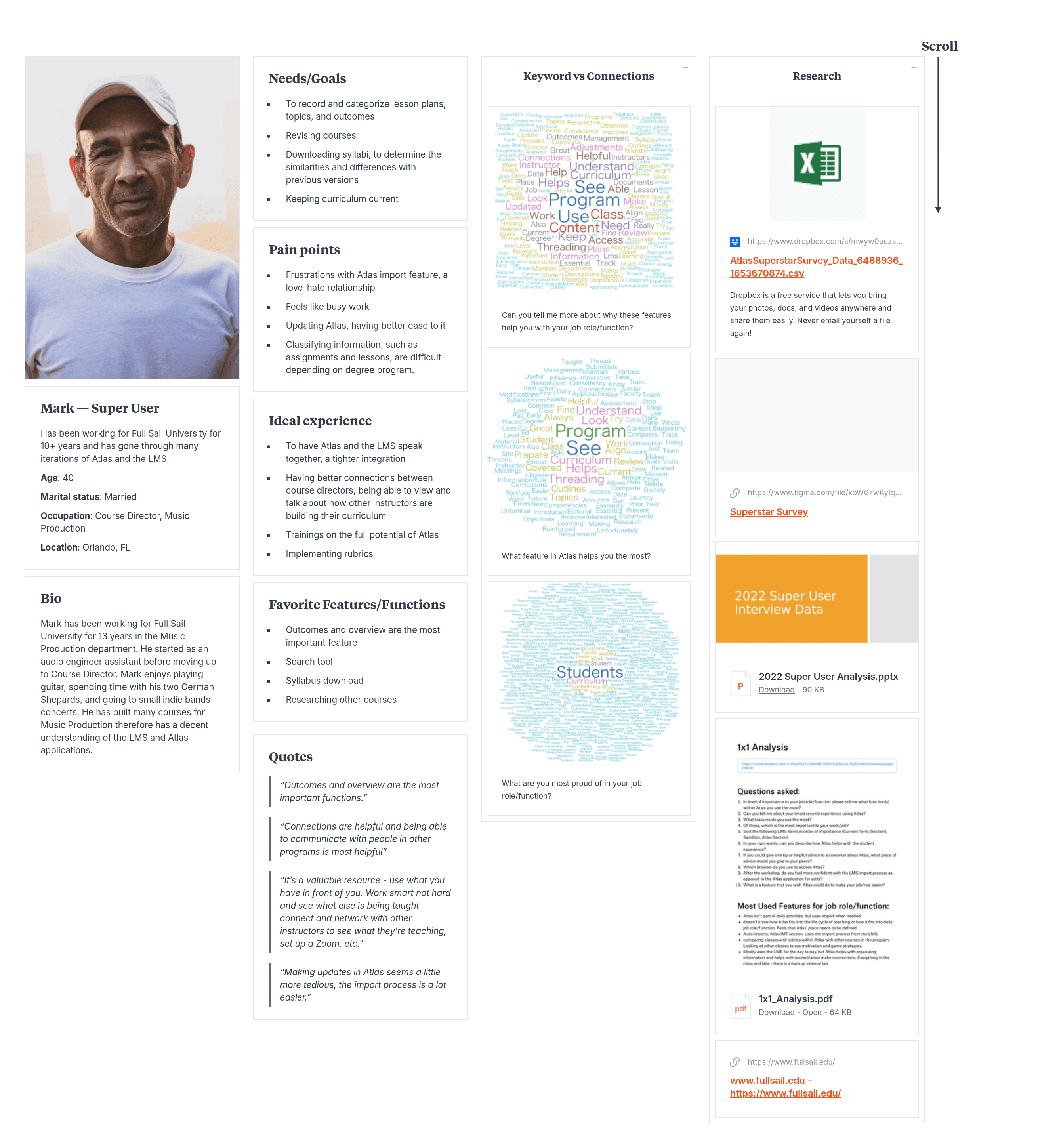
Three personas developed from research: The Skeptic, The Eager Adopter, The Middle Manager

Monthly faculty workshops — building community buy-in across 200+ stakeholders
What Research Can Actually Do
The best research doesn't just describe what's wrong — it reframes what the problem actually is. That's what changed everything here.— On the Atlas research process